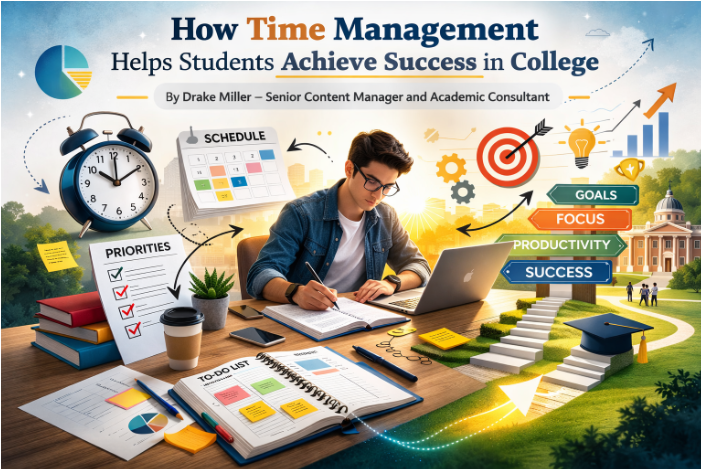
How Time Management Helps Students Achieve Success in College
By Drake Miller – Senior Content Manager and Academic Consultant
The transition from high school to college is often described as a leap into independence. While the academic rigor certainly increases, the most profound shift isn’t found in a textbook—it’s found in the clock. In college, you are no longer operating within the structured 7:00 AM to 3:00 PM confines of a high school hallway. Instead, you are faced with vast gaps of “free time” that can either be the foundation of your success or the catalyst for a semester-long scramble.
Mastering time management is not just a helpful habit; it is the most critical skill for surviving and thriving in higher education. Here is why time management dictates college success and how you can master it to achieve your academic goals.
The “Autonomy Shock”: Why College is Different
In high school, teachers and parents often act as external regulators. They remind you of deadlines, check your progress, and ensure you are awake for your exams. In college, that safety net vanishes. A professor might hand out a syllabus on day one with a 3,000-word research paper due in week twelve, and you may never hear them mention it again until the day it’s due.
Without a robust system to manage these long-term obligations, students often fall victim to the “Planning Fallacy”—the tendency to underestimate how much time a task will take. This is particularly true for technical subjects; for instance, a student might realize too late that they need specialized MATLAB assignment help to debug complex code before a deadline. High-achieving students succeed because they respect the complexity of their schedules and recognize that a “free” Tuesday morning is a prime opportunity for deep analytical work.
1. Quality of Output: Beyond the Minimum
There is a significant difference between finishing an assignment and mastering the material. When you start a project forty-eight hours before the deadline, you are in survival mode. You are looking for the quickest way to meet the word count, often sacrificing critical thinking for completion.
Conversely, effective time management allows for the “Incubation Phase” of creativity. When you draft an essay a week early, your brain continues to process arguments in the background. If you find yourself struggling to articulate these thoughts, collaborating with a professional assignment writer can provide the structural guidance needed to turn a rough draft into a polished submission.
With extra time, you can:
- Visit the campus writing center for professional critique.
- Engage in peer reviews with classmates.
- Conduct a deeper literature review to find more authoritative sources.
- Thoroughly proofread for clarity and tone.
2. The Direct Link Between Time Management and Mental Health
One of the most overlooked aspects of time management is its impact on psychological well-being. Chronic procrastination leads to “active stress”—the constant, nagging anxiety of knowing you have work to do while you are trying to relax. This “dark playground” prevents true recovery, leading to burnout before midterms even arrive.
When you manage your time effectively, you eliminate the toxic “all-nighter” culture. Scientific research, including studies from the American Academy of Sleep Medicine, consistently shows that sleep deprivation impairs cognitive function as much as alcohol intoxication. By scheduling “deep work” sessions during the day, you protect your sleep and social life, leading to a more balanced and fulfilling college experience.
3. Combating the “Cost of Switching”
In the digital age, the greatest enemy of time management is the “Switching Cost.” Every time you stop studying to check a notification or respond to a text, it takes your brain an average of 23 minutes to return to a state of deep focus.
College students who master time management understand the value of “Time Blocking.” By dedicating specific, uninterrupted hours to a single subject, they achieve more in two hours than a distracted student achieves in six. This efficiency creates more time for internships, networking, and extracurriculars—the high-impact activities that actually build a professional resume.
Strategies for Mastery: How to Take Control
If you feel like your schedule is controlling you, it’s time to implement a strategic framework.
The Eisenhower Matrix
Use this four-quadrant system to categorize your to-do list:
- Urgent & Important: Do these immediately (e.g., an exam tomorrow).
- Not Urgent & Important: Schedule these (e.g., long-term research, exercise).
- Urgent & Not Important: Delegate or minimize (e.g., certain social invites).
- Not Urgent & Not Important: Eliminate (e.g., mindless scrolling).
The Pomodoro Technique for Stamina
Break your work into 25-minute sprints followed by a 5-minute break. This keeps your brain fresh and prevents the burnout that comes from staring at a screen for four hours straight. It turns studying into a manageable series of “wins.”
Digital Auditing
Use tools to track where your time actually goes. A digital audit might reveal three hours of daily social media usage. Reclaiming even half of that time can transform your GPA and give you back 10 hours of freedom every week.
The Long-Term ROI: Professional Readiness
The importance of time management extends far beyond the campus gates. In the professional world, managers do not give “partial credit” for late work. In high-stakes corporate or research environments, missing a deadline can have financial consequences.
Employers look for graduates who can self-start and manage multiple streams of responsibility without constant supervision. By treating your college schedule as a training ground, you develop the discipline required for high-level leadership roles.
Balancing Academic Rigor and Personal Growth
The goal of time management isn’t to turn you into a robot. Rather, it is to provide the structure necessary for freedom. When you know exactly when your work will be done, you can enjoy your downtime without guilt.
For many students, the pressure of maintaining this balance can be overwhelming, especially when faced with complex research methodologies. In these instances, seeking academic guidance or utilizing resources that help streamline the research process can be a wise time-management decision in itself. Knowing when to ask for help and where to find reliable academic support is a hallmark of a mature student.
Frequently Asked Questions
Q.1 Why is time management harder in college than in high school?
In high school, your day is externally structured. College introduces “unstructured time”—large gaps between classes where no one is telling you what to do. Without self-discipline, these gaps are lost to passive leisure.
Q.2 What is the “Planning Fallacy”?
It is a cognitive bias where students underestimate the time needed for a task. Experts recommend “buffer nesting”—adding 25% more time to your initial estimate to account for unexpected complexities.
Q.3 Is the Pomodoro Technique effective for long sessions?
Yes. The human brain’s focus declines after 50 minutes. Sprints prevent cognitive fatigue and maintain a higher “quality of focus.”
Q.4 How can I manage time if I have a part-time job?
“Time Blocking” is essential. Treat study hours like work shifts—non-negotiable appointments. Utilizing academic support can also help manage the heavy lifting of research during busy work weeks.
Q.5 Does digital auditing really help?
Most students underestimate digital distractions by 50%. Reclaiming just one hour a day from scrolling gives you the equivalent of nine full work weeks of productive time per year.
Conclusion
Time is the only resource in college that is truly finite. As you navigate your higher education journey, treat your calendar with the same respect as your GPA. Start small—plan your next 24 hours tonight. Once you master your minutes, the years of college success will follow naturally. You don’t need more time; you just need a better plan.